
The Early Years
Office of the Surgeon General of the Army Various locations in downtown Washington, DC
The National Library of Medicine began quite humbly, as a few books in the office of the Surgeon General of the Army. The first request for funds for the library—$150 for medical books—appeared in the 1836 estimate of expenses for the Surgeon General’s Office, and in 1840 the office issued its first “catalogue of books in the library.” As historian Wyndham D. Miles noted in his 1982 history of NLM, “The entire collection [as listed in that 1840 catalog] could have been held by a four-shelf bookcase, shoulder high and 7 or 8 feet wide.” Although the collection grew under Thomas Lawson, Surgeon General from 1836 to 1861, it was still insignificant and disorganized if one accepts the appraisal of Joseph J. Woodward, who served in the Surgeon General’s office from 1862 to 1864: “At the time the late Civil War broke out nothing deserving the name of a medical library existed in Washington.


In 1862, the Surgeon General’s library was moved to the Riggs Bank Building at 15th and Pennsylvania, NW, in Washington, DC. The library issued its first printed catalogue in 1864, listing approximately 2,100 volumes. One year later, with the closing of the Army’s temporary Civil War hospitals and the consolidation of their libraries, the Surgeon General’s office got a windfall of medical books and journals.

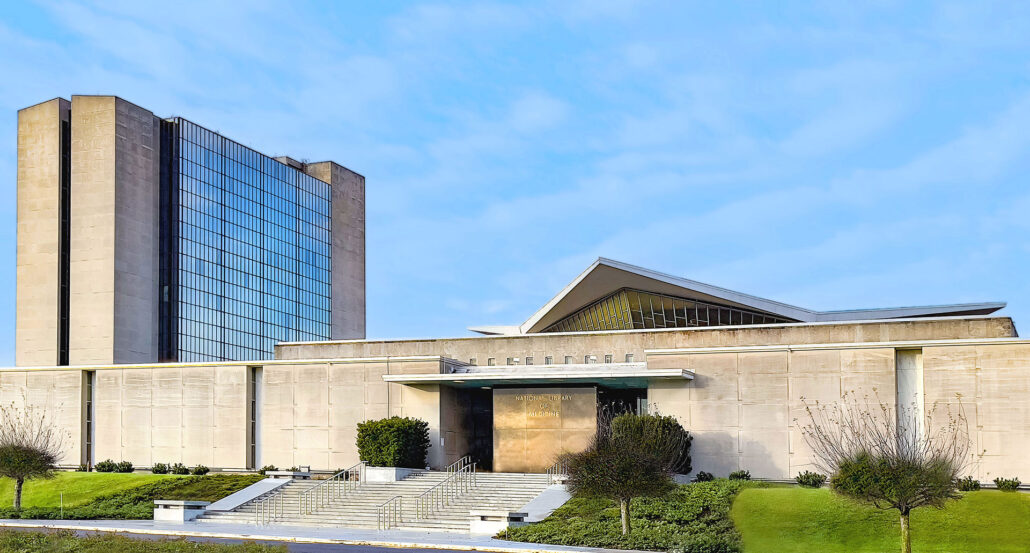
A 1956 act of Congress transferred the library to the Public Health Service and named it the National Library of Medicine. Senators Lister Hill and John F. Kennedy were the driving force behind the bill. Kennedy would see his vision realized in 1962 when, during his presidency, NLM opened its doors on the campus of the National Institutes of Health in Bethesda, Maryland.
The new National Library of Medicine took its place on the NIH campus in 1962, on the wooded site of a former golf course. Designed to protect the collection from possible Cold War threats, the building features foot-thick limestone walls, over 50 miles of subterranean bookshelves and a collapsible roof. The computer era has blossomed here, with the establishment of the Lister Hill National Center for Biomedical Communications in 1968, the creation of MEDLINE in the 1970s, the establishment of the National Center for Biotechnology Information in 1988, the introduction of free MEDLINE in 1997, the creation of consumer-friendly MedlinePlus in 1998, and the introduction of ClinicalTrials.gov and PubMed Central in 2000, among other developments. Meanwhile, the collection has grown dramatically and with it the number of interlibrary loan requests filled. NLM now partners with over 20 nations and has expanded its outreach efforts to consumers and health professionals around the globe.